Current Grants:
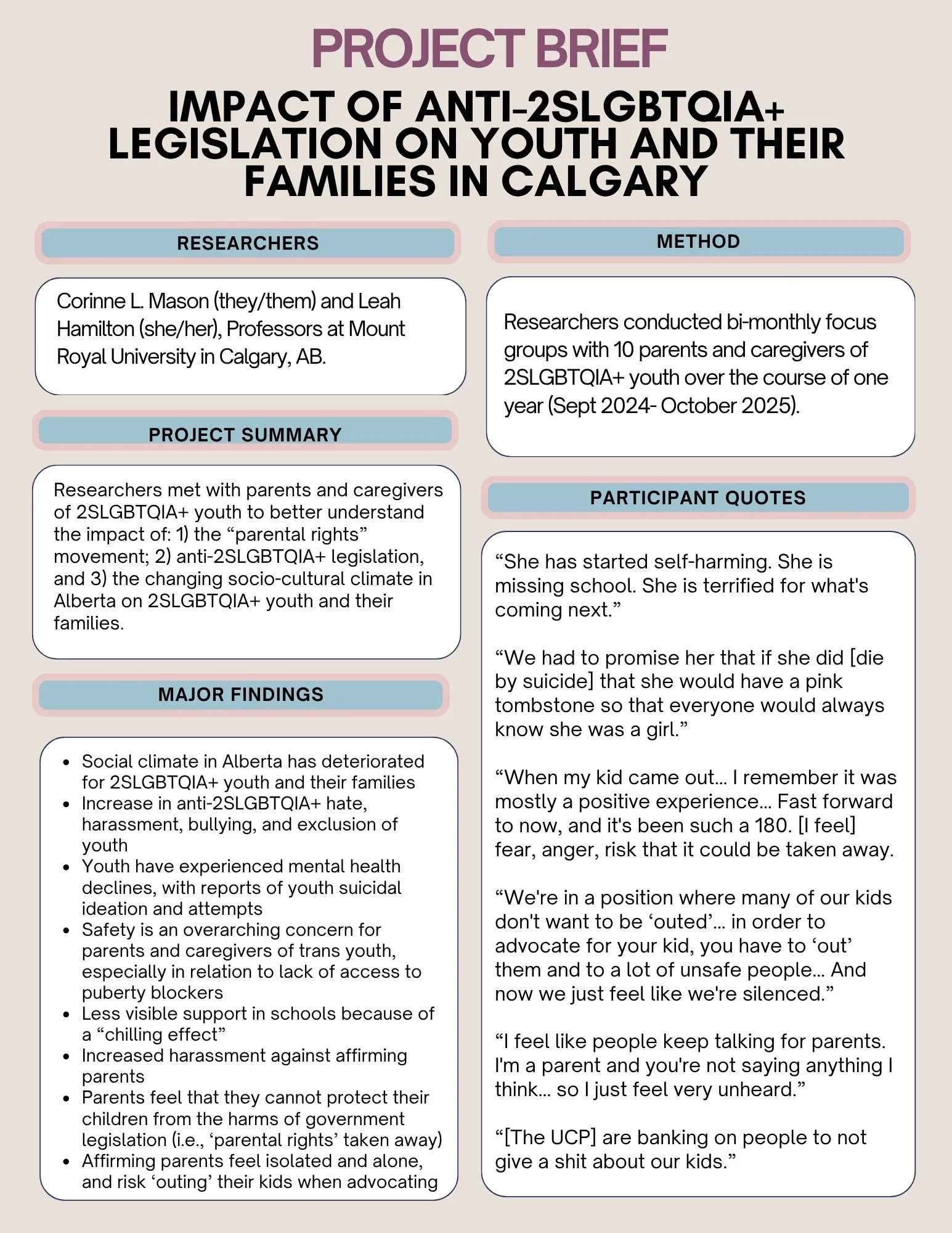
I hold a 2025 SSHRC Insight Development Grant with Leah Hamilton entitled “Tracing the impacts of the anti-2SLGBTQIA+ legislation in Alberta on queer families.” The major objective of our project is to examine the impacts of the contemporary parental rights movement— and associated anti-2SLGBTQIA+ legislation— on queer families in Alberta. Based on preliminary findings from our 2024 SSHRC Explore-funded pilot study, we are now conducting serial focus groups in Calgary and Edmonton, collecting data through a province-wide survey, and interviewing parents and caregivers across Alberta.
I am the PI on a 2026 Scholarship of Teaching and Learning grant entitled “‘The Bill Chill’: Teaching and Learning about Gender and Sexual Diversity in Contemporary Alberta” with Jill Thompson, Lisa Gasson-Garnder, and Victoria Butcholtz. This research focuses on the “chilly climate” for teaching and learning about sexual and gender diversity at MRU in the context of Alberta’s current socio-political climate.
I am a collaborator on the SSHRC Insight project “Transformative Encounters: Gender and Sexuality Pedagogies in Canada.” (Natalie Kouri-Towe, PI).
Grants Completed:
I served as a co-investigator on a 2023 SSHRC Explore Grant (internal) entitled “Exploring Gender Euphoria through Arts-Based Action Research with Youth.” This project investigated how Calgary-based trans and gender creative (TGC) youth and their caregivers defined and experienced “gender euphoria.” In arts-based focus groups, TGC youth and caregivers worked with social artists to create of digital murals representing their experiences. These murals can be viewed at the Metta Clinic and Skipping Stone Foundation in Calgary.
I recently held 2021 SSHRC Insight Development Grant to investigate the impact of social distancing measures on 2SLGBTQIA+ communities in Alberta and Manitoba during the COVID-19 pandemic. Framed by queer theory’s expansive definition of family and kinship, the project aimed to unpack the experiences of 2SLGBTQIA+ folks navigating “stay-at-home” measures that disconnected community members from their social supports. I am the Co-PI on this project with Deb McPhail (PI) alongside team members Fenton Litwiller and Robert Lorway. We are currently working on a community-facing report and writing academic articles based on the findings from this study.
Finally, I completed a 2019 SSHRC IDG project (with Irene Shankar) that explored feminist faculty responses to sexualized violence across (what is colonially known as) Canada. In the wake of #MeToo, Canadian universities found themselves under pressure to respond to sexualized violence on their campuses, and struggled to do so. Perplexingly, postsecondary institutions had access to feminist expertise on campus, but this didn’t always translate into robust responses, especially for Black, Indigenous, racially minoritized, 2SLGBTQIA+, disabled and/or neurodivergent members of campus communities.